


Cooperation between ST and MicroControl –
CAN FD Driver Implementation on the New STM32C5 MCU
Implementing a CAN FD driver for the new STM32C5 MCU was completed in a very short time, taking only about two days. Most of this time was spent carefully reviewing the reference manual and analyzing the technical details of the new MCU. The documentation provided by ST significantly simplified the adaptation process, particularly through clear register descriptions and well-structured configuration guidance.
The performance advantages of the STM32C5 over the STM32C0 series become especially apparent when implementing CAN FD protocols, particularly in combination with MicroControl’s CANopen FD Master stack. The larger RAM capacity and higher clock speeds of the C5 series enable more robust handling of complex CAN FD message processing and arbitration mechanisms.
A major advantage of the STM32C5 is its ability to use the extended clock tree. This makes it possible to configure the CAN bus interface clock precisely to 40 MHz. As a result, the STM32C5 supports reliable communication at high data rates and is well suited for demanding CAN FD applications that require both performance and precision.
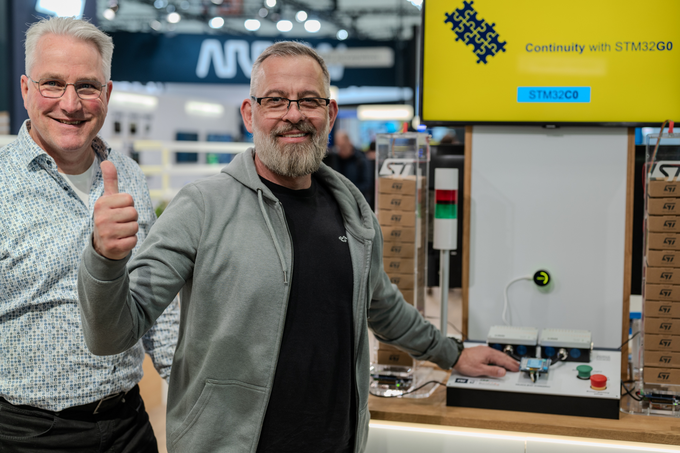
The project was carried out as part of the ST Partner Program to showcase an application using MicroControl’s CANopen Master protocol stack on ST’s new STM32C5 controller. The solution was presented at the ST booth during embedded world 2026.